

Describe the task in observable terms
Choose a defined workflow such as scheduling follow-up, routing an information request or monitoring an administrative queue. State the starting event, required input and evidence of completion. “Support the front desk” is too broad to establish responsibility. A narrow task description helps the practice identify the training, supervision and systems needed and avoids assuming that remote access alone creates a usable process.
Name the decision boundary
Identify which questions the assistant can answer from approved instructions and which require practice, clinical or billing review. A scheduling task can uncover a clinical concern that needs the designated clinical team.
A coordinator should know that escalation path before the first real interaction. Do not let the convenience of a shared queue blur responsibility for care decisions, coding determinations or payer outcomes.

Move from the question to the next action
Agree on access and information handling
List the systems needed for the actual tasks, the approving owner and how access will be reviewed or removed. Use the practice’s approved secure communication process.
HHS business-associate guidance is relevant where the actual arrangement involves the regulated handling of protected health information. This article and a public download do not establish compliance or replace the agreements and operational safeguards appropriate to the scope.
Test the handoff with fictional work
Walk through a normal administrative request and exceptions: missing information, an unavailable recipient and a clinical question. Confirm that the assistant can identify the next owner and record the outcome in the designated system.
The test should reveal ambiguous instructions before patient-level work begins. Keep an unresolved exception visible instead of allowing an assistant to guess simply to close a task.
Review the scope as the work changes
Use recurring questions to decide whether instructions, training or access need revision. Changes should be approved and communicated deliberately.
The primary care checklist can track anonymous process checks such as whether a handoff route is defined; it is not a patient-contact log. Discuss the desired remote administrative workflow with SBS so responsibilities and service fit can be scoped around your practice rather than assumed from a general service label.
Illustrative workflow
A practical example.
Fictional workflow: an assistant is assigned to coordinate routine scheduling follow-up. During a fictional test, a request includes a clinical question. The practice identifies the clinical recipient and backup before launch. The assistant’s task remains routing and administrative tracking; the clinician owns the care response. The completed scope records the approved systems, task boundary and evidence of handoff.
Put it into practice
- Define the task’s input, owner and completion evidence.
- Set clinical and administrative escalation routes.
- Approve the actual access and information-handling arrangement.
Inside the workbook
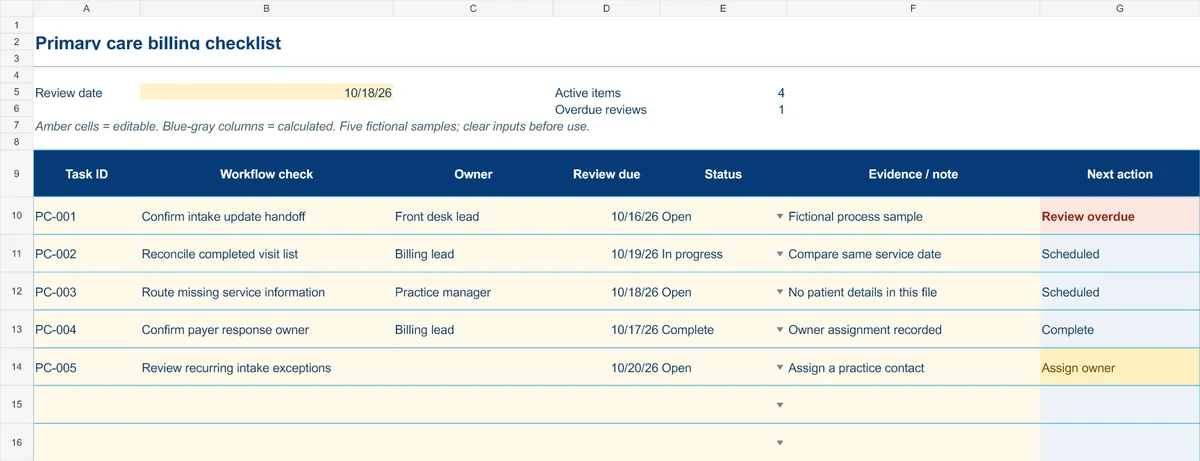
Start with the Instructions tab. Replace the five fictional samples, set your review date and keep the formula columns intact.
Free XLSX tool · No signup
Primary care billing checklist
Daily process checks across intake, encounter reconciliation and payer follow-up.
- 50 prepared task rows and five fictional examples
- Owner, review date, status and evidence notes
- Calculated next-action reminders
Use anonymous process tasks. Keep PHI in approved systems. Includes instructions and fictional samples; no macros or live data connection.