

Agree what work is moving
Document the services, queues, providers, locations and reporting responsibilities in scope. State what remains with the practice and which decisions need approval.
A handoff is easier to control when both parties can identify its starting population and expected outputs. Avoid transferring a broad unresolved backlog without agreeing how the incoming team will distinguish missing information, payer follow-up and authorized adjustment decisions.
Plan the actual information flow
Identify the systems and records needed for the defined tasks and the approved exchange channel. Keep the first public inquiry limited to business needs; detailed records can follow the appropriate scoped process.
The receiving team should know the source of each report, the filters applied and the person who can explain it. More copied data is not automatically a better handoff if its meaning or permitted use is unclear.

Move from the question to the next action
Review agreements and access responsibilities
Where the arrangement involves protected health information, the practice and partner need to address the applicable obligations and arrangements for that actual work. HHS business-associate and minimum-necessary guidance provide relevant reference points.
Name the access approver, review owner and removal process. Do not treat a signed document, a website badge or the use of a spreadsheet as proof that every operational safeguard has been implemented.
Test a bounded workflow
Use a defined, appropriately handled sample to confirm that source records can be understood, questions reach an accountable practice contact and authorized outcomes return to the right system. Include an exception that needs clinical or coding review.
Confirm the reporting definition before comparing results. The test should expose gaps in responsibility and access rather than become a reason to infer that every historical item has been resolved.
Preserve closeout and transition evidence
Record what was handed over, the agreed source dates, known limitations and outstanding dependencies. Establish how the parties communicate changes and how records and access are handled when scope ends.
The internal medicine workflow tracker can coordinate anonymous transition tasks, but it is not a secure record-transfer service. Discuss your systems and scope with SBS before exchanging patient or claim information through an approved channel.
Illustrative workflow
A practical example.
Fictional workflow: a practice plans to move payer follow-up to a support partner. The transition review discovers that a report includes both insurance and patient balances, while the proposed scope covers only one category. The parties clarify the population, name the practice decision contact and test the exception route. The final handoff records the agreed scope rather than transferring an unexplained total.
Put it into practice
- Define the transferred work and retained decisions.
- Approve information exchange and system access.
- Test the exception route and preserve transition evidence.
Inside the workbook
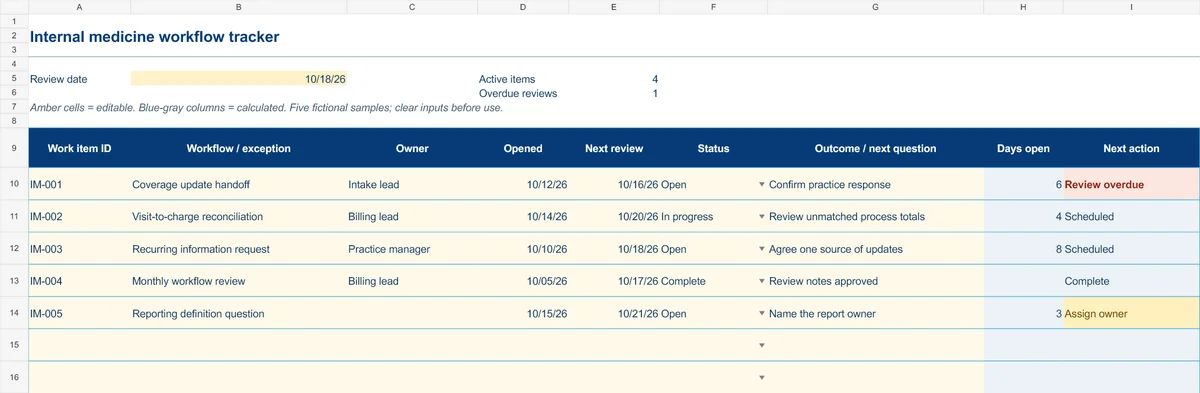
Start with the Instructions tab. Replace the five fictional samples, set your review date and keep the formula columns intact.
Free XLSX tool · No signup
Internal medicine workflow tracker
Coordinate recurring administrative exceptions, responsibilities and follow-up.
- 50 prepared operational work-item rows
- Opened date, next review and outcome notes
- Calculated days open and next actions
Use anonymous process tasks. Keep PHI in approved systems. Includes instructions and fictional samples; no macros or live data connection.