

Map the service and organization
List the actual service workflow, care setting and organizations involved using the practice’s authorized records. An outside test result appearing in the chart does not by itself establish who bills that service.
Identify the relevant billing entity and designated contact before assigning follow-up. This first map should describe what happened, not assume that every step belongs on the same claim or under the same organization.
Separate missing facts from a coding determination
A coordinator may need to confirm the location, provider or source of a service record. A qualified coding reviewer may need to determine how the documented service should be reported.
Keep those questions distinct so an administrative handoff does not predetermine the answer. When the record is unclear, ask a precise question through the approved clarification process and preserve the authorized response.

Move from the question to the next action
Check the applicable coverage and edit reference
CMS maintains Medicare coverage and NCCI resources for relevant review. The qualified reviewer should identify the current document, service date and applicability to the actual claim context. Avoid assuming that a familiar service combination is always reportable or that a modifier resolves any edit.
Other payers may apply their own requirements. The workflow should make the source used for the decision traceable without turning an educational article into a coding instruction.
Send the question to the organization that can resolve it
An unresolved item may require the practice’s service detail, a payer explanation or information from another organization. Identify what each party can actually answer and keep the supporting reference with the request.
Do not send the same broad question to every participant. A good handoff names the missing fact, the relevant approved record and the responsible person, with a review date for the response.
Close the administrative loop
Record what was confirmed and whether any separate billing decision remains open. If another organization owns the service question, preserve the transfer reference and the practice contact who will monitor it.
Use an anonymous operational tracker to coordinate the handoff while detailed service and claim records remain in approved systems. A later process review can examine repeated responsibility confusion and improve the original information route.
Illustrative workflow
A practical example.
Fictional workflow: a cardiology office sees an unresolved balance associated with a diagnostic workflow. The initial review finds that staff have not established which organization performed the billed service. The coordinator confirms the relevant source and contact before asking for coding review. The resulting task goes to the responsible organization, while the practice retains a clear record of what it still needs to monitor.
Put it into practice
- Map the actual service, setting and billing organization.
- Keep administrative facts separate from coding decisions.
- Record the responsible contact and unresolved next question.
Inside the workbook
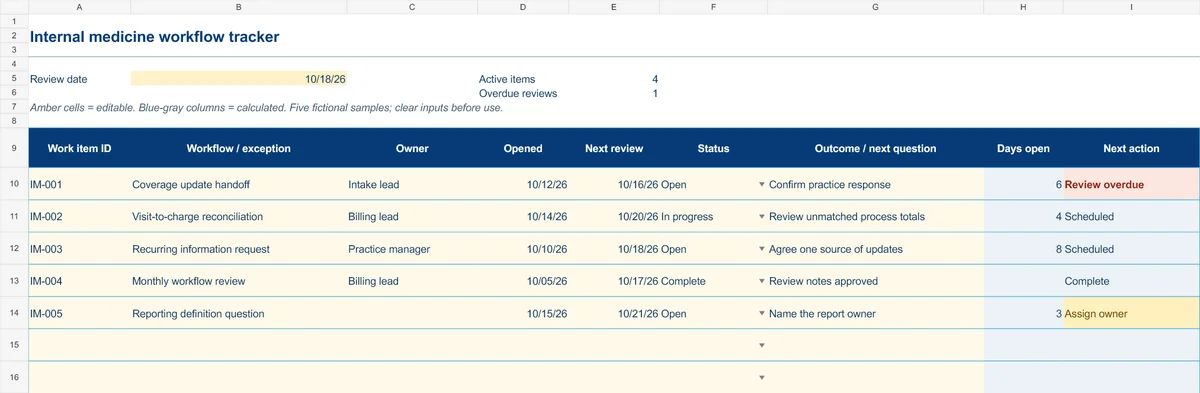
Start with the Instructions tab. Replace the five fictional samples, set your review date and keep the formula columns intact.
Free XLSX tool · No signup
Internal medicine workflow tracker
Coordinate recurring administrative exceptions, responsibilities and follow-up.
- 50 prepared operational work-item rows
- Opened date, next review and outcome notes
- Calculated days open and next actions
Use anonymous process tasks. Keep PHI in approved systems. Includes instructions and fictional samples; no macros or live data connection.